Fibre laser welding is very good at joining clean, close-fitting sheet metal. It puts heat into a narrow area, so thin panels are less likely to distort and the finished seam can need less dressing. TIG gives the welder close control of the weld pool. MIG handles gaps and heavier fabrication more readily. Many workshops will have a use for laser welding without giving up either arc process.
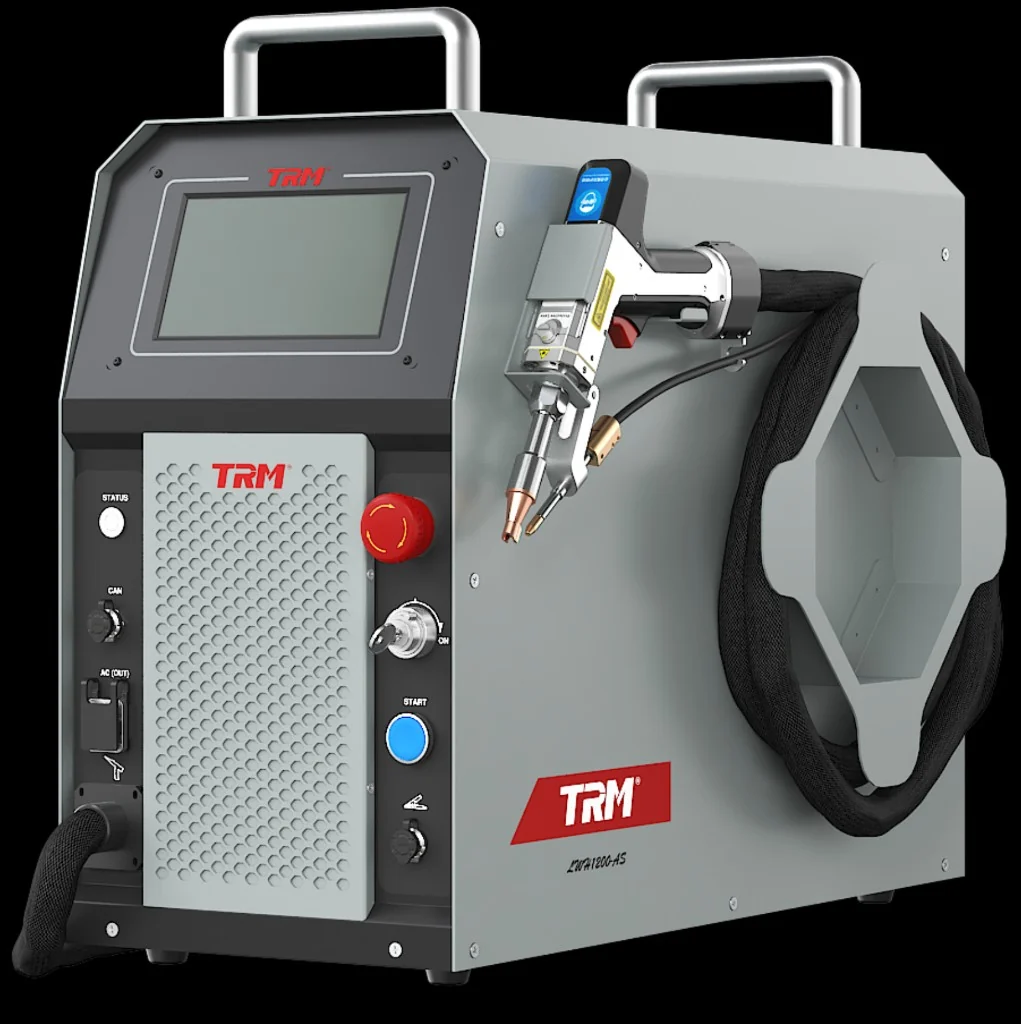
Laser welding suits clean, close-fitting sheet-metal work. If that matches your parts, compare the four TRM G3 fibre laser welders. The buyer’s guide covers cooling, power and working duty.
How each process works
TIG creates an arc between a tungsten electrode and the workpiece. Filler rod is added separately when it is needed. The operator can watch and control the weld pool closely, which is useful on awkward joints, repairs and work where the appearance of the weld matters.
MIG feeds wire continuously through the welding gun. The wire carries the arc and provides the filler metal, making MIG a practical choice for general fabrication and joints that need more fill.
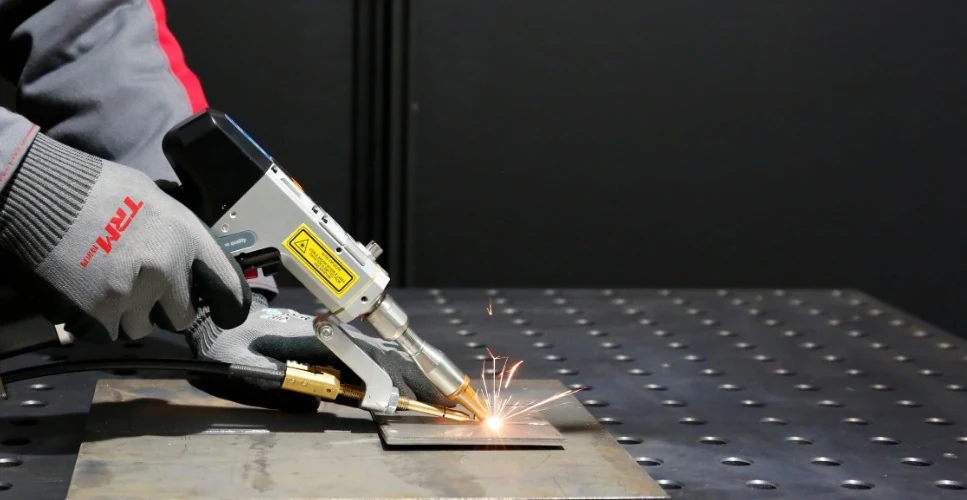
A fibre laser welder sends a concentrated beam through a fibre to the handheld welding head. The heat is focused into a narrow seam. With clean material, close fit-up and the correct shielding gas, it can travel quickly across thin stainless, mild steel and aluminium while keeping distortion down. Enclosures, stainless assemblies, light fabrication and automotive repair are all typical applications.
Laser welding needs a well-made joint
This is where many comparisons fall down. Laser welding needs clean edges and a reasonably consistent gap. If the parts rock in the fixture, the gap changes along the seam or the surface is oily or scaled, the result will suffer. More laser power will not correct poor preparation.
TIG gives the operator more time to work around an awkward area. MIG puts filler into the joint continuously and copes better when a gap needs filling. If most of your work arrives with variable fit-up, improving the parts and fixtures may matter more than changing the welding process.
Parts cut on a fibre laser can move straight into welding when the edge is clean and the fit-up is accurate. Nitrogen-cut stainless, for example, avoids the oxidised edge left by oxygen cutting. Our guide to cutting stainless and aluminium explains the difference where cutting and welding form one production route.
Heat and distortion
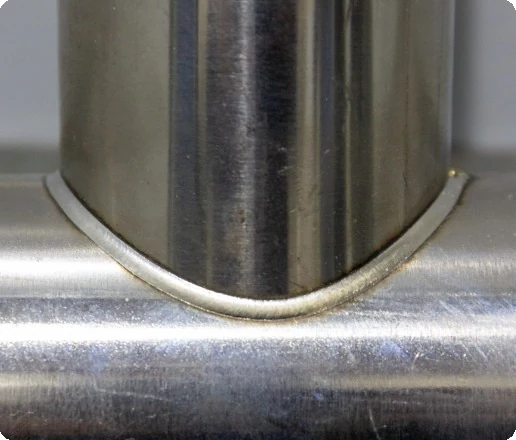
Thin panels can move as a weld cools. Because the laser concentrates its heat into a narrow seam, less of the surrounding sheet is heated than with a typical TIG weld on the same gauge. Panels tend to stay flatter, with less straightening needed after welding.
Weld strength still has to be judged against the material, joint and inspection standard. A neat laser bead may also need blending when it sits on a visible face.
Production speed and repeatability
Fibre laser welding usually travels faster than MIG on thin-gauge work with good fit-up. The biggest gains tend to come from repeat parts that load and clamp cleanly. Awkward access, slow handling or extra finishing can quickly eat into that advantage.
The TRM G3 control has Easy and Expert modes with more than 110 built-in presets. An operator can start from a suitable preset, test it on the part and record the setup that works. Consistent parts and fixtures are still essential; the controls cannot make an uneven joint repeatable.
Materials and thickness
The TRM G3 range can weld stainless steel, mild and carbon steel, aluminium, copper, brass and other reflective alloys. The exact grade and joint still matter. If different metals are being joined, check the welding advice from the material supplier first.
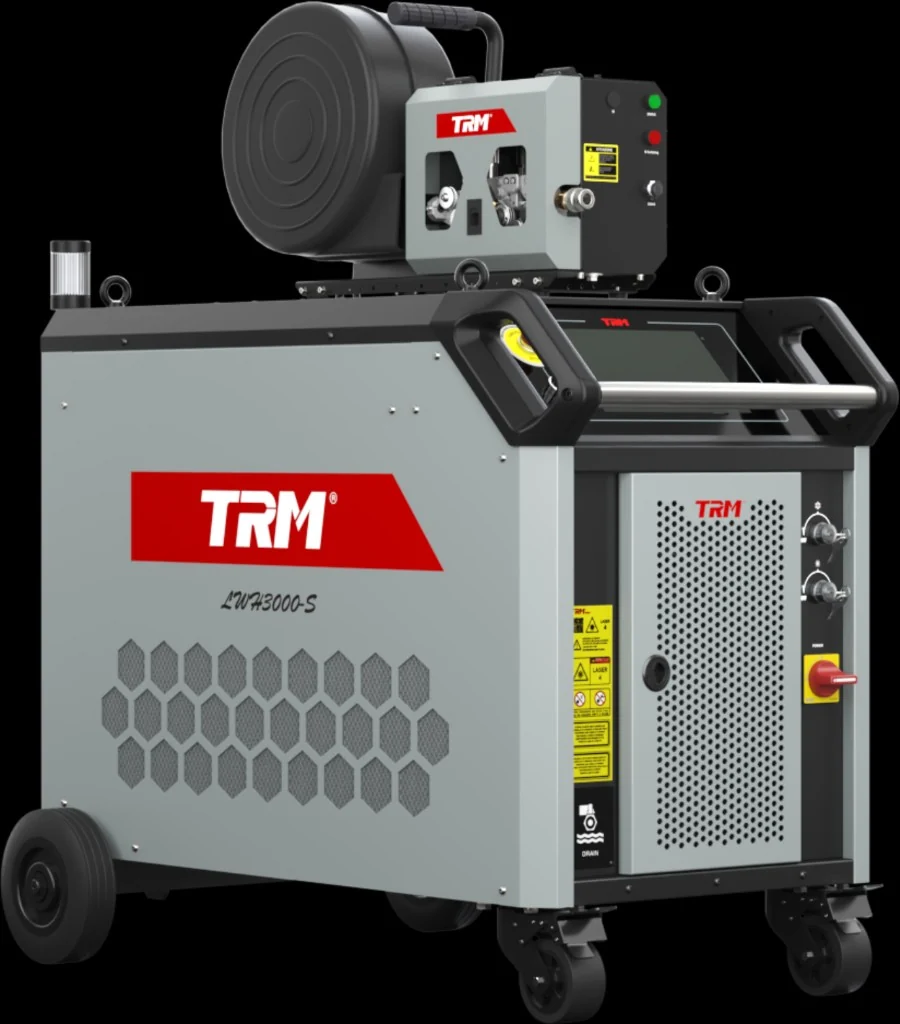
TRM suggests a workpiece range of 0.4–4 mm for the 1.2kW and 1.5kW machines, 0.4–6 mm for the 2kW model and 0.4–8 mm for the 3kW LWH3000-S. These are selection guides rather than guaranteed limits. Material grade, joint design, fit-up and shielding gas all affect the result. Thick sections and joints needing plenty of fill are generally better suited to TIG or MIG.
Filler wire and shielding gas
Laser welding does not always need filler wire. A close-fitting sheet-metal joint can often be welded without it. Wire may be needed to bridge a gap, suit the joint design or follow an approved welding procedure. Every TRM G3 includes a single wire feeder, with a multi-wire feeder available as an option.
The shielding gas is supplied by the customer. TRM specifies argon or nitrogen, with the choice depending on the metal and the job. Gas supply and consumption should therefore be included when planning the installation.
What operators notice
An experienced TIG or MIG welder already understands cleanliness, fit-up, shielding gas and what a sound joint should look like. The hand movement is different with a laser: travel is quicker, the seam is narrow and the head must follow a steady path. Operators need training on the controls, the welding technique and the laser-safety procedures. On-site training can be included in the quotation.
Laser welding needs a controlled area
A handheld fibre laser welder is Class 4 equipment. A standard welding screen and helmet do not provide a complete laser-safety system. The installation needs a controlled welding area, suitable viewing protection, interlocks, extraction and working procedures. These requirements are a major difference from adding another TIG or MIG set to the workshop.
Which process fits the job
| The work | Laser welding | TIG | MIG |
|---|---|---|---|
| Thin stainless or aluminium, consistent fit-up | Well suited to fast, narrow seams with low distortion | Good control where appearance or access matters | Useful when the joint also needs filler |
| Enclosures, light fabrication, repair on thin gauge | Well suited to clean, close-fitting parts | Useful for awkward areas and visible welds | Useful where the joint needs more filler |
| Wide gaps, poor fit-up, heavy contamination | Parts need better preparation first | More control around a variable joint | Usually the most practical of the three |
| Thickness above the suggested laser range, or a large fill | Better handled by an arc process | Suited to controlled, lower-volume work | Suited to general production fabrication |
| Site work without a planned laser cell | Requires a suitable Class 4 controlled area | Often easier to arrange on site | Often easier to arrange on site |
If you regularly weld clean, close-fitting sheet metal, see the four TRM G3 fibre laser welders. Send us a drawing or sample of a typical joint so the machine can be considered against the work. Call the UK team on 0121 541 1444 or Mantech Ireland on (+353) 83 804 8820.
Useful next reads
- TRM fibre laser welders
Compare all four G3 machines, from the portable air-cooled model to the 3kW water-cooled system.
- How to choose a fibre laser welder
Work through cooling, power, working hours, wire feeding and Class 4 safety.
- Cutting stainless and aluminium
See how cutting gas and edge quality affect parts that will be welded afterwards.
- Mantech machinery applications
Browse common cutting, forming, welding and fabrication work.
Frequently asked questions
Can a fibre laser welder replace TIG?
It can replace some TIG work on clean, close-fitting sheet, especially where keeping distortion down matters. TIG remains useful for awkward joints, repairs and work where the welder needs close control of the weld pool.
Can a fibre laser welder replace MIG?
It can be a quicker, cleaner option for well-prepared thin sheet. MIG remains better suited to wider gaps, heavier fabrication and joints that need more filler metal.
Which process gives the neatest finish?
Laser welding can leave a narrow, neat bead on prepared sheet and often reduces the amount of dressing needed. TIG gives the welder more control when the finished appearance has to be worked by hand. Either process may still need blending on a visible face.
Does laser welding need filler wire?
Not always. Close-fitting sheet can often be welded without filler. Wire is used when the gap, joint design or welding procedure calls for it. Every TRM G3 includes a single wire feeder, and a multi-wire feeder is optional.
When is TIG or MIG the better choice?
TIG or MIG is usually the better choice when fit-up varies, the section is too thick for the laser, the joint needs plenty of filler, or the work cannot be carried out in a suitable Class 4 controlled area. An existing approved TIG or MIG procedure may also be best left in place.