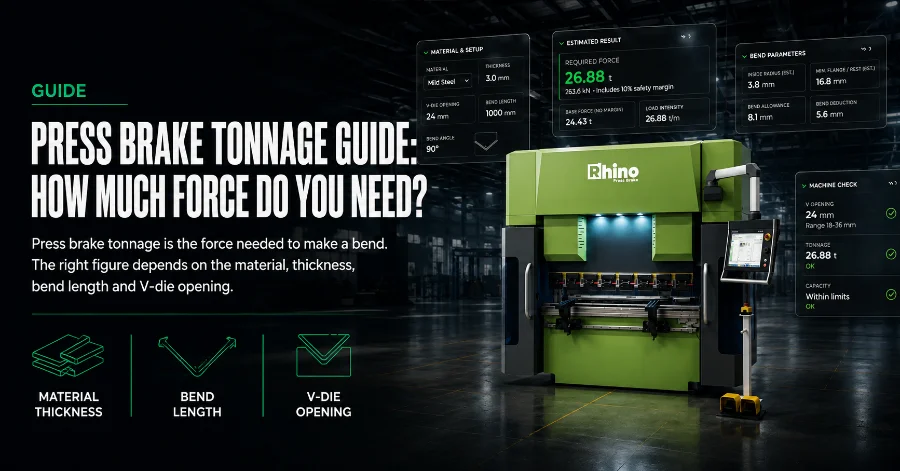
Press brake tonnage is the force needed to make a bend. Choose too little and the machine may not complete the job safely. Choose far more than your work requires and you pay for capacity that spends most of its life unused. The right figure comes from the material, thickness, bend length and V-die opening — not thickness alone.
Work from your regular bends rather than one unusually heavy job. Use the bending calculator for each material, thickness, bend length and V opening, then compare the result with the complete Rhino torsion bar range and Rhino Premium CNC range. Machine and tooling limits must be checked together.
The short answer
- Calculate your longest and heaviest regular bends, not one exceptional job.
- Use the tensile strength of the actual material where possible.
- Choose the V-die opening before calculating force because a narrower opening needs more tonnage.
- Check both total machine tonnage and the punch and die rating in tonnes per metre.
- Leave sensible headroom and confirm the final setup against the machine and tooling charts.
Use our press brake bending calculator for a quick estimate. This guide explains what changes the result and how to use it when comparing Rhino torsion bar and Rhino Premium CNC press brakes.
What press brake tonnage means
A machine described as 100T can apply a nominal force of 100 metric tonnes-force across an approved setup. That does not mean it can safely apply the full force at any point on the bed. Short bends concentrate the load, off-centre bending can twist the machine and every punch and die has its own limit. Always follow the manufacturer’s load chart.
Machine tonnage is only one limit. The working length must cover the bend, the tooling must withstand the load per metre and the part must sit safely on the die shoulders.
The four inputs that decide bending force
| Input | What it means | Effect on force |
|---|---|---|
| Material strength | Ultimate tensile strength (UTS), measured in MPa | Stronger material needs more force |
| Thickness | Sheet thickness at the bend line | Force rises sharply as thickness increases |
| Bend length | Length of material being bent in one stroke | Twice the bend length needs roughly twice the force |
| V-die opening | Distance across the die opening | A narrower V needs more force; a wider V needs less |
The grade matters. Our calculator uses 450 MPa as a mild-steel starting point, 620 MPa for 304 stainless and 170 MPa for a typical soft aluminium sheet. These are planning values, not guarantees. Use the material certificate when the result is close to a machine or tooling limit.
A practical air-bending formula
For metric air-bending estimates, Mantech uses: force in kN = 1.42 × tensile strength in MPa × thickness² in mm × bend length in metres ÷ V opening in mm. Divide the result by 9.80665 to convert kilonewtons to metric tonnes-force.
This is a planning calculation for air bending. Bottoming and coining use different force levels. Grain direction, material batch, punch radius, die wear and setup can also change the real result, so the calculation must be checked against tooling data and a test bend.
Why the V-die opening matters
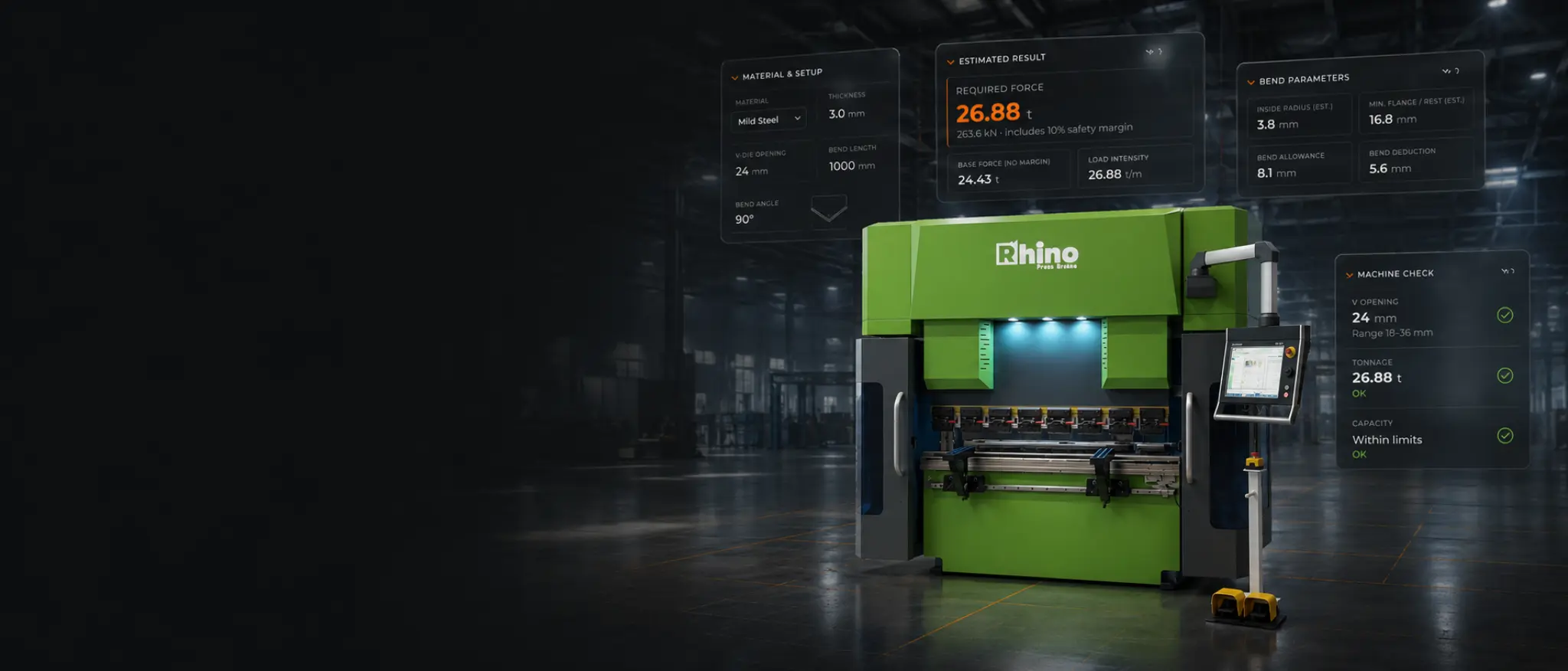
A common starting point for air bending is a V opening around eight times the material thickness. A practical range is often six to twelve times thickness, depending on the part and tooling. For 3 mm sheet, an 8T starting point is therefore a 24 mm V opening.
- A narrower V produces a smaller natural radius and supports shorter flanges, but raises force and marking risk.
- A wider V reduces force, but produces a larger inside radius and needs a longer flange.
- For a mild-steel estimate, inside radius is roughly 16% of the V opening.
- The minimum flange resting on the die is roughly 70% of the V opening.
These ratios are useful starting points. The finished angle and radius still need to be proved with the actual material, punch and die.
Worked tonnage examples
The examples below use air bending, the material values in Mantech’s calculator and an 8T V opening. They show the estimated base force before any additional headroom.
| Material and job | V opening | Bend length | Estimated force |
|---|---|---|---|
| 2 mm mild steel | 16 mm | 1,000 mm | About 16.3 tonnes |
| 3 mm mild steel | 24 mm | 1,000 mm | About 24.4 tonnes |
| 3 mm stainless 304 | 24 mm | 1,000 mm | About 33.7 tonnes |
| 5 mm mild steel | 40 mm | 2,000 mm | About 81.4 tonnes |
The stainless example needs more force than mild steel at the same thickness because the assumed tensile strength is higher. The 5 mm example also shows the effect of bend length: the same setup over one metre would need roughly half the force.
Total tonnes and tonnes per metre are not the same
A long bend spreads force across more tooling. A short bend can put a heavy load into a small section of punch and die. Divide the required force by bend length in metres to find tonnes per metre, then compare that figure with the tooling rating. A job may sit within the machine’s total capacity and still overload the tooling.
Do not assume unused bed length makes a concentrated bend safe. Check the machine’s permitted load distribution and avoid off-centre work unless the manufacturer specifically allows it.
How tonnage relates to Rhino press brake models
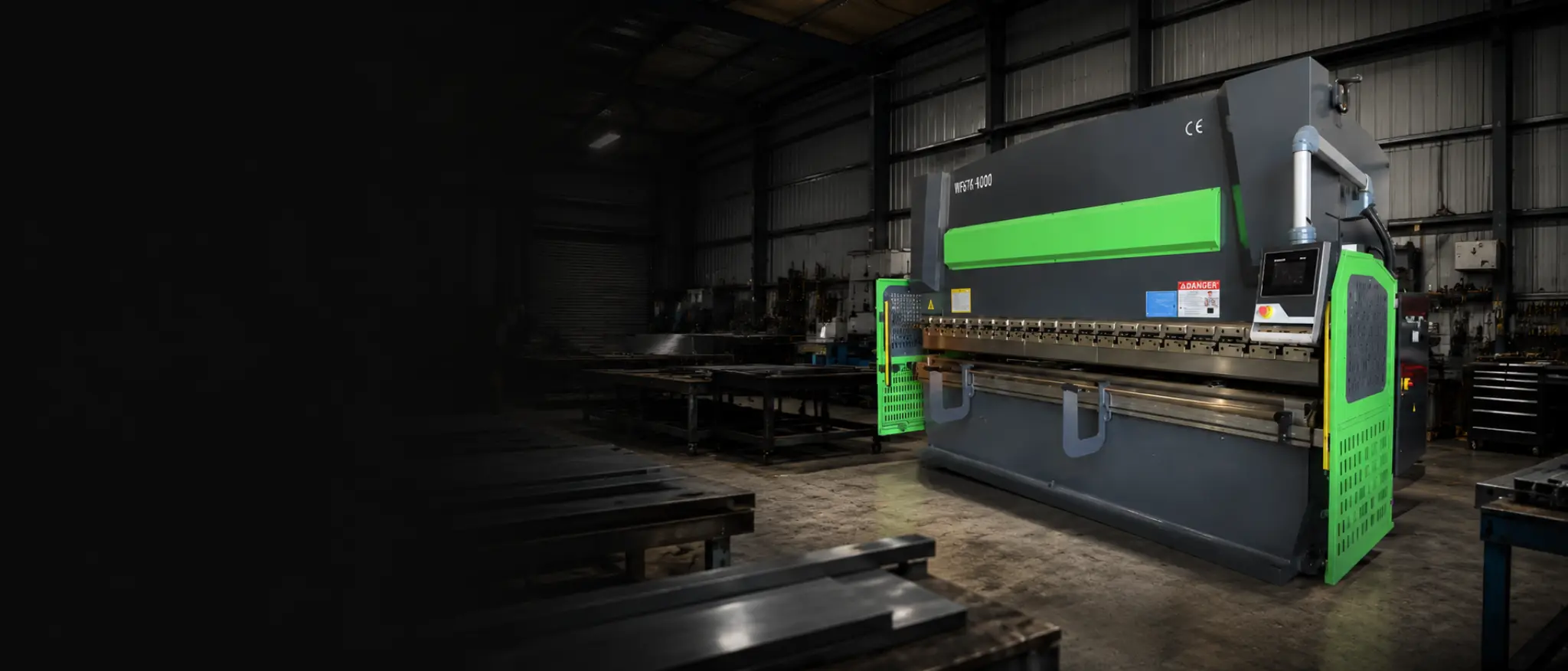
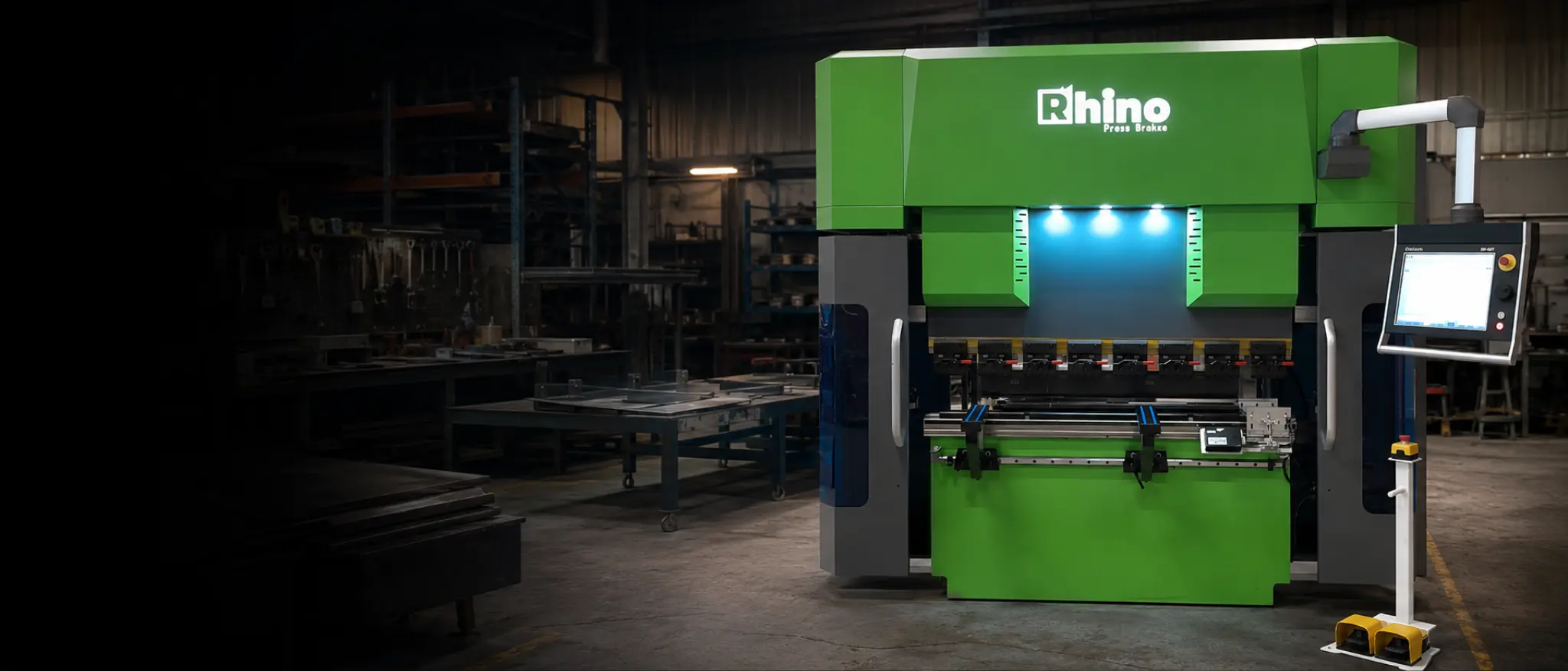
The Rhino W67Y torsion bar range runs from 40T to 400T with working lengths from 1.3 m to 6 m. Rhino Premium CNC machines cover 40T to 300T with working lengths from 1.6 m to 4 m. The figures below are popular torsion bar configurations, not automatic recommendations.
| Model | Rated force | Working length | Typical starting point |
|---|---|---|---|
| W67Y-40/1600 | 40T | 1,600 mm | Light-gauge work and compact workshops |
| W67Y-80/3200 | 80T | 3,200 mm | General fabrication and medium-duty bending |
| W67Y-100/3200 | 100T | 3,200 mm | Regular production sheet-metal work |
| W67Y-160/3200 | 160T | 3,200 mm | Heavier-gauge and higher-duty production |
Do not select a machine simply because an estimate falls below its badge tonnage. Allow for material variation, the intended tooling, load distribution and the work you expect to add in future. Bed length and daylight may rule out a model even when its force looks sufficient.
See the complete model tables on the Rhino torsion bar range. If your work needs multi-axis backgauging, crowning and tighter production control, compare the Rhino Premium CNC range and read torsion bar vs CNC press brake.
Common tonnage mistakes
- Choosing a machine from sheet thickness without considering bend length or material grade.
- Using a mild-steel chart for stainless steel.
- Changing to a narrower die without recalculating the force.
- Checking total machine tonnes but not the tooling limit in tonnes per metre.
- Running too close to rated capacity with no allowance for material variation.
- Ignoring minimum flange length, inside radius or safe load distribution.
Use the calculator, then confirm the setup
Enter the material, thickness, bend length and angle in the press brake bending calculator. Start with the suggested 8T V opening or enter the die you plan to use. The result includes estimated force, tonnes per metre, inside radius and minimum flange. You can also compare it with a selected machine capacity.
Run your jobs through the free bending calculator, then check the result against the press brake and tooling manufacturer’s charts. For the wider decision on bed length, controls, tooling and installation, read how to choose a CNC press brake.
Discuss your bends with Mantech
Bring several typical drawings to the discussion, including your longest bend, thickest regular material and any short flanges. Mantech can check the force, tooling and working length together, then recommend a Rhino configuration that suits the work rather than one isolated calculation.
Explore Rhino torsion bar press brakes, compare Premium CNC press brakes, or call 0121 541 1444. See machines working in UK workshops on installations.
Useful next reads
- Press brake bending calculator
Estimate air-bending force, V opening, radius and minimum flange.
- How to choose a CNC press brake
The wider UK guide to bed length, controls, tooling and installation.
- Torsion bar vs CNC press brake
Compare affordable torsion bar bending with Premium multi-axis CNC.
- Rhino torsion bar press brakes
Full W67Y range from 40T to 400T and 1.3 m to 6 m.
- Rhino Premium CNC press brakes
Multi-axis CNC bending from 40T to 300T.
- Kes Power & Lighting case study
A 100T Rhino press brake working in UK electrical manufacturing.
Frequently asked questions
How do I calculate press brake tonnage?
For a theoretical metric air-bending estimate, use material tensile strength, thickness, bend length and V-die opening. Mantech’s formula is force in kN = 1.42 × tensile strength × thickness² × bend length in metres ÷ V opening. Divide kN by 9.80665 for metric tonnes-force. The free calculator completes this calculation for you.
How much tonnage is needed to bend 3 mm mild steel?
Using a 24 mm V opening, a 1,000 mm bend and a 450 MPa mild-steel value gives an estimated base force of about 24.4 tonnes. A two-metre bend would need roughly twice that force. Confirm the material, tooling and machine load chart before bending.
Does stainless steel need more press brake tonnage?
Usually, yes. Stainless generally has a higher tensile strength than mild steel, so the same thickness, bend length and V opening need more force. In the examples above, 3 mm 304 stainless needs about 33.7 tonnes per metre compared with 24.4 tonnes for the mild-steel baseline.
Does a wider V-die reduce tonnage?
Yes. A wider V opening reduces the force needed for air bending, but it also increases the natural inside radius and minimum flange length. Choose the die around the finished part and tooling limits, not simply to bring the tonnage figure down.
Can I use the full rated tonnage anywhere on the bed?
No. Rated machine tonnage does not mean the full force is safe at every position or over every bend length. Short or off-centre bends can concentrate the load. Check the machine load-distribution chart and the punch and die ratings before setting the job.