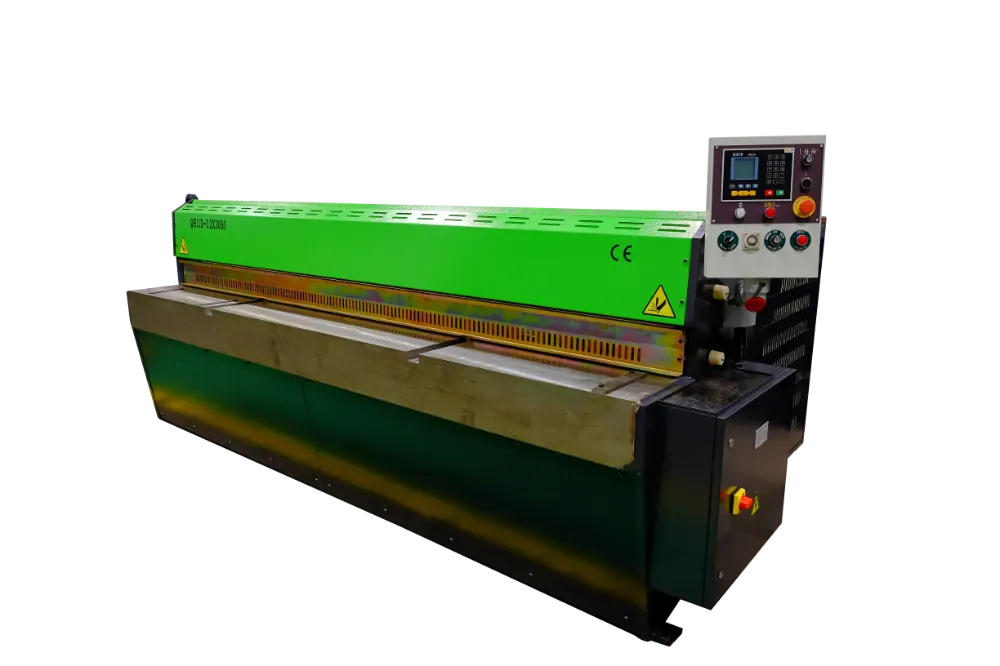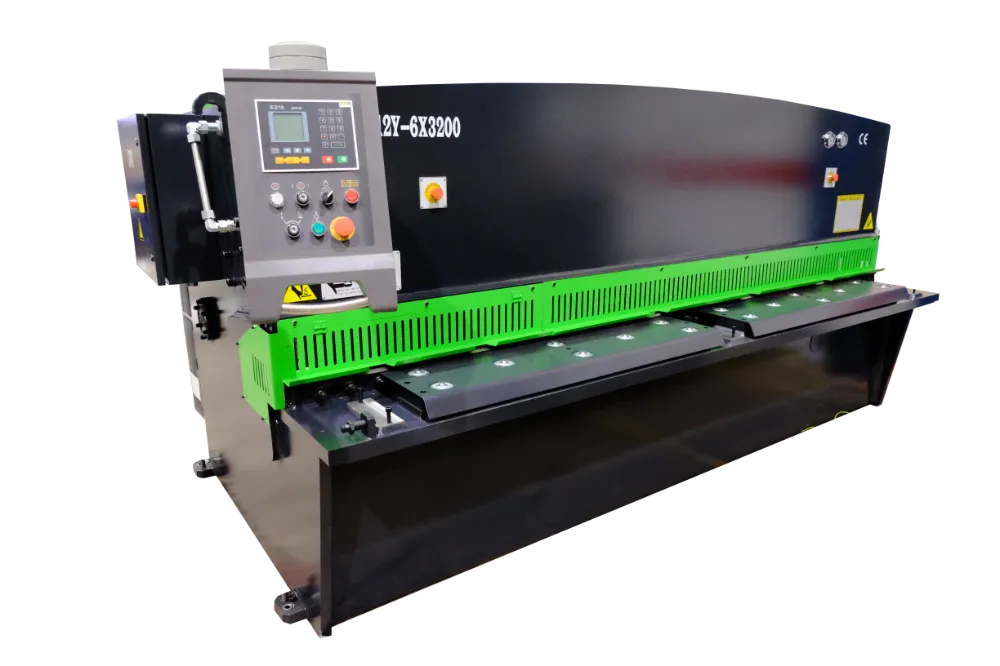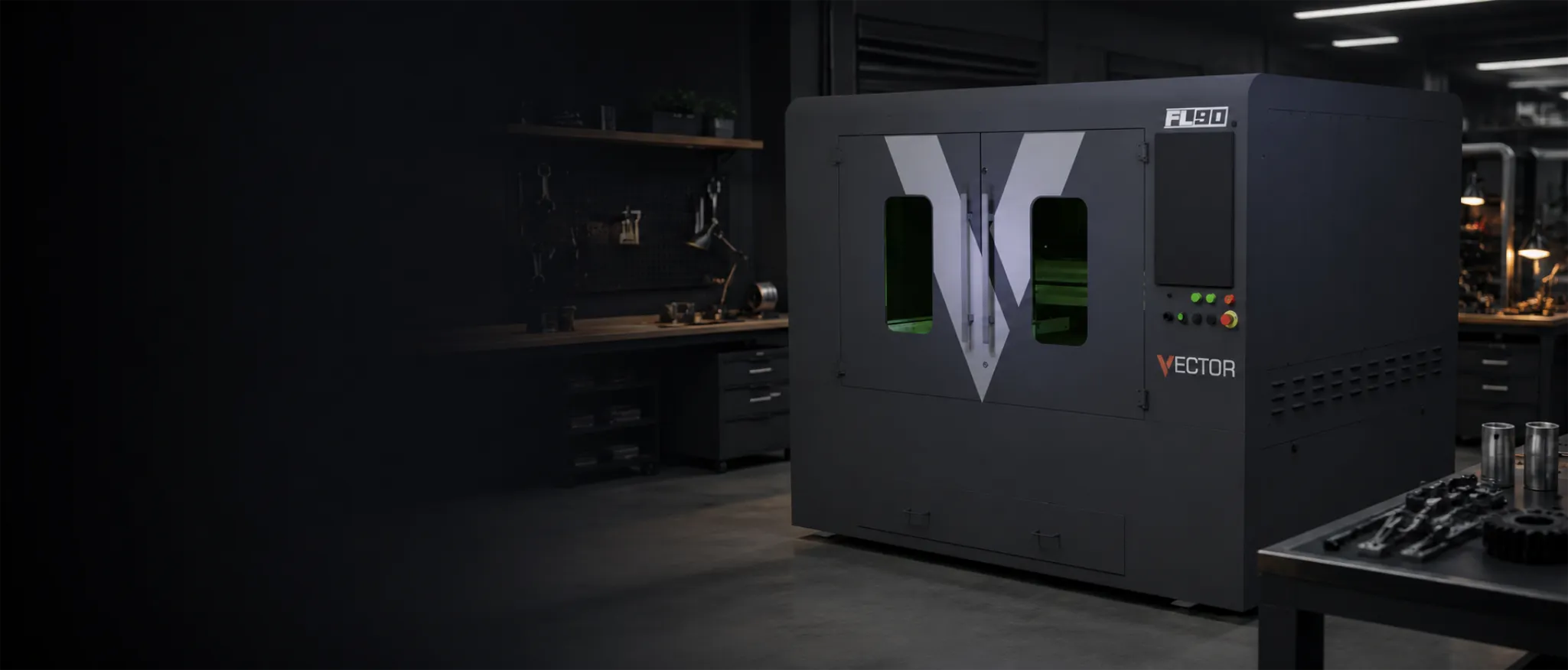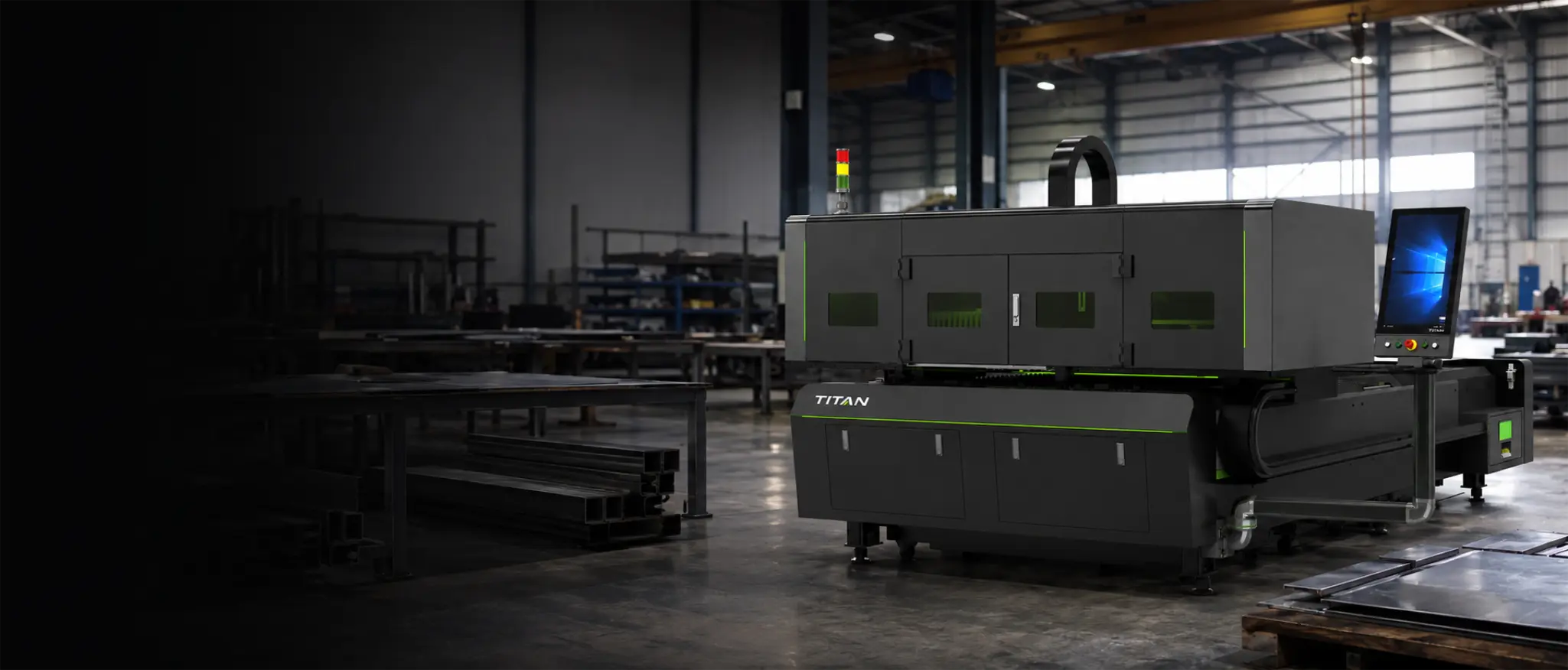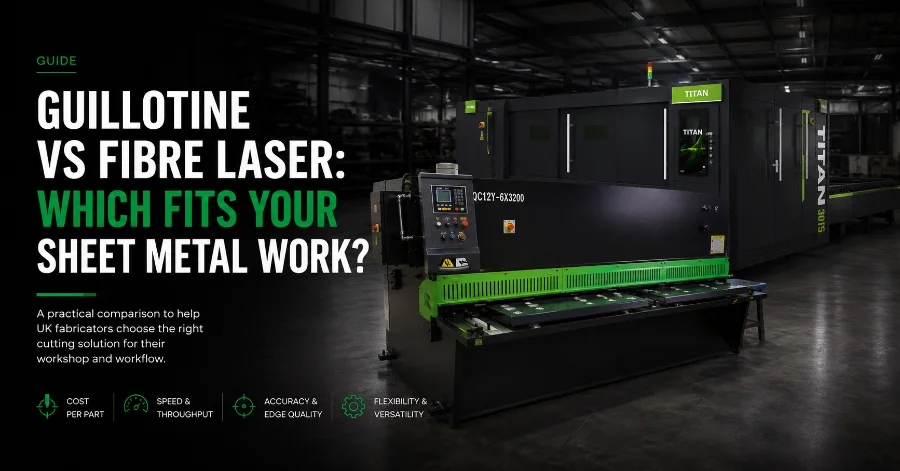
A guillotine and a fibre laser can both turn full sheets into usable parts, but that is where the similarity ends. A guillotine is a production tool for straight cuts: strips, rectangles and blanks prepared quickly for folding or bending. A fibre laser earns its floor space when the part itself carries the complexity — profiles, holes, slots, tabs and shapes nested across the sheet. The right choice is therefore less about which machine is “better” and more about what leaves the cutting stage ready for the next operation.
Straight blanks and profiled parts create different bottlenecks. Compare mechanical and hydraulic shearing on the Rhino guillotine hub, check UK guide prices in the industrial guillotine cost guide, position Vector and Titan on the fibre laser hub, and test representative sheet layouts with the sheet yield calculator before you commit simple and complex work to the same machine.
The short answer: look at the geometry on the drawing
- Choose a guillotine when most work is made from straight, full-width or repeated rectangular cuts.
- Choose fibre laser when parts contain profiles, internal features or mixed shapes that would need further processing after shearing.
- Keep both in the conversation when a workshop produces simple blanks alongside nested components — each machine can remove work from the other.
- Judge the complete route to a finished part, not a single headline cutting speed.
Compare the full Rhino guillotine range and Vector and Titan fibre laser cutters. If bending follows cutting, the press brake buyer guide covers the next stage of the cell.
What each process actually does
A guillotine shear drives an upper blade past a fixed lower blade to separate the sheet in a straight line. The backgauge sets the blank dimension; the operator positions the stock, and the machine repeats the cut. On Rhino machines, Estun E21S NC control and a motorised backgauge support repeat batches across both the mechanical MEG and hydraulic ranges.
A fibre laser follows a programmed toolpath. A focused beam melts the material while assist gas clears the kerf, allowing the machine to cut outer profiles and internal details in one nest. That flexibility changes the production question: instead of asking how quickly one straight cut can be made, the buyer asks how many finished profiles can leave one sheet with the least handling and secondary work.
Guillotine vs fibre laser — practical comparison
| Factor | Industrial guillotine | Fibre laser |
|---|---|---|
| Part geometry | Straight strips, rectangles and square blanks | Profiles, holes, slots, tabs and mixed shapes |
| Programming | Blank dimensions and repeat backgauge positions | CAD/CAM nest and cut parameters |
| Material use | Efficient grid cutting for rectangular blanks | Dense nesting for irregular or mixed parts |
| Cut edge | Sheared edge with roll-over, burnish, fracture and possible burr | Narrow thermal kerf; edge depends on material, power and gas |
| Secondary work | Needed if the blank later requires holes or profiling | Many features can leave the nest already cut |
| Batch changeover | Fast when dimensions and material remain simple | Programme-led; strong where batches and geometries vary |
| Operating profile | Blades, clearance, backgauge and mechanical/hydraulic service | Electricity, assist gas, optics, extraction and software |
| Best fit | Reliable straight blank preparation | Flexible finished-part cutting |
Where a guillotine is difficult to beat
For repeated rectangular blanks, a guillotine is direct and easy to understand. There is no need to create a nest for every strip or square. Once the backgauge positions are set, the work moves through a simple cut-and-stack rhythm. That matters in fabrication shops feeding press brakes with doors, panels, brackets and enclosure blanks all day.
- Long straight cuts and repeated widths dominate the order book.
- The cut blank goes directly to a press brake, folder or another established operation.
- Operators need quick dimensional changes without building a fresh CAD/CAM nest.
- The workshop wants a dedicated blanking machine rather than tying up a profile cutter with simple rectangles.
Rhino mechanical and hydraulic guillotines share E21S NC backgauge control but cover different duty levels. The range page owns the detailed mechanical-vs-hydraulic and capacity decision. For real-world proof, see the HWGTA guillotine case study and Rhino hydraulic installation in Norfolk.
Where fibre laser changes the economics
Fibre laser becomes more persuasive as soon as the drawing carries work that a shear cannot complete. A hole, radius or shaped edge means a guillotined blank must visit another machine. On a laser nest, those features are cut in the same cycle. The saving is not only cutting time; it can be fewer handoffs, less work-in-progress and fewer chances to lose datum or orientation between operations.
- Profiles and internal features make up most of the part rather than a minority of jobs.
- Orders combine several part numbers or geometries on the same sheet.
- Stainless, aluminium and mild-steel parts need a repeatable programmed route with less follow-on profiling.
- The business is bringing subcontract laser work in-house or quoting work it cannot make with straight blanking alone.
Compact and mid-format buyers can compare Vector FL90 and Vector FL130. Production flatbed routes include the Titan N Series. Match power to the everyday material mix in the fibre laser power guide.
Material yield is not one simple percentage
A fibre laser is usually stronger at nesting irregular parts around one another. A guillotine can be exceptionally efficient when the sheet divides cleanly into rectangular blanks. In other words, the drawing decides the waste pattern. Quoting a universal yield advantage for either process ignores part shape, grain or finish constraints, edge allowances and the value of reusable offcuts.
Run representative jobs rather than a perfect demonstration nest. Use the same sheet size, same order quantity and the same downstream requirements. Then count saleable parts, usable remnants, handling steps and any secondary cutting. The result is far more useful than comparing kerf width in isolation.
Test rectangular layouts and mixed-part scenarios with the sheet yield calculator. For broader process examples across UK sectors, browse machinery applications.
Edge condition: sheared is different, not automatically worse
A correctly set guillotine produces a characteristic sheared edge: roll-over at entry, a burnished section, fracture and a small burr at exit. Blade condition, clearance, hold-down and material all affect the result. Fibre laser produces a thermal edge whose kerf, striation and heat effect change with material, thickness, power, focus and assist gas. Neither description supports a blanket claim that one edge is always cleaner.
The useful question is whether the edge is acceptable for what happens next. A hidden blank going straight into a bend may not need a laser-cut finish. A visible stainless component, close-fitting assembly or profiled part may justify the laser route because it removes later cutting and dressing. Take sample drawings and material to a demo and inspect the complete part, not a hand-picked coupon.
When the strongest answer is both
Many fabrication businesses do not have one cutting problem. They have a regular stream of rectangular blanks, plus a smaller but valuable mix of profiled parts. A guillotine keeps simple work off the fibre laser; the laser absorbs complexity that would otherwise need drilling, notching or subcontracting. That division protects capacity on both machines.
| Typical job | Likely first route | Reason |
|---|---|---|
| Repeated enclosure blanks before bending | Guillotine | Straight dimensions and fast repeat backgauge work |
| Bracket with holes, slots and radiused corners | Fibre laser | Outer profile and internal features in one nest |
| Mixed stainless components across several part numbers | Fibre laser | Programme-led nesting and fewer secondary operations |
| Long strips cut from standard sheet | Guillotine | Direct straight blanking without consuming laser time |
| Workshop producing both blanks and detailed profiles | Both | Separate simple throughput from complex part cutting |
A better way to make the decision
- Export six months of jobs and group them by straight blank, profiled part and mixed route.
- Record material, thickness, sheet size, batch quantity and every operation after the first cut.
- Price handling, drilling, notching, dressing and subcontract lead time — not only machine cycle time.
- Run one rectangular batch and one difficult mixed nest through both proposed workflows.
- Check what must remain available during maintenance; two complementary machines can add useful resilience.
- Confirm installation, extraction, training and service requirements before comparing total ownership.
Talk through your actual parts
Mantech supplies Rhino mechanical and hydraulic guillotines alongside Vector and Titan fibre laser cutters from Halesowen. That means the conversation can start with your drawings rather than a predetermined machine. Bring the parts you make repeatedly, the jobs you subcontract and the blanks that currently hold up bending; our engineers can help separate straight-cut volume from profile-cutting demand.
Explore industrial guillotines and fibre laser cutters, call 0121 541 1444, or use the quote form on either range page. UK installation evidence is available through machinery installations.
Useful next reads
- Rhino industrial guillotines
Mechanical vs hydraulic selection, capacities, E21S control and full specifications.
- How much does an industrial guillotine cost?
UK guide prices from £8,160 +VAT mechanical and £14,800 +VAT hydraulic.
- Vector and Titan fibre laser cutters
Compare compact, mid-format and production flatbed platforms.
- Fibre laser cutting guide
How the process works, material fit and platform choices.
- How to choose a CNC press brake
Plan the bending stage that follows straight blanking or laser cutting.
- Sheet yield calculator
Compare simple blank layouts and mixed-part sheet use.
- HWGTA guillotine case study
Mechanical and hydraulic guillotines used in engineering training.
Frequently asked questions
Can a fibre laser replace a guillotine?
It can replace many cutting operations, but that does not make it the best use of laser capacity. If most work is straight strips and rectangular blanks, a guillotine remains a direct production route. Fibre laser is stronger when profiles and internal features remove several later operations.
Is a guillotine faster than a fibre laser?
For one repeated straight cut, a guillotine can be exceptionally quick. For a finished bracket with holes, slots and shaped edges, the fibre laser may complete in one nest what a sheared blank still needs several machines to finish. Compare total route time, not a single cut.
Which process wastes less sheet metal?
It depends on geometry. Guillotines can divide sheets efficiently into rectangular blanks; fibre lasers can nest irregular parts closely. Compare the same order quantity and count saleable parts, reusable remnants and downstream scrap before declaring a winner.
Which gives the better cut edge?
The edges are different. Guillotines create a sheared edge governed by blade condition and clearance. Fibre lasers create a thermal edge governed by material, power, focus and assist gas. The better edge is the one that meets the next operation and finished-part requirement with least rework.
Should a fabrication workshop own both?
Often, yes — when there is enough straight blanking and profiled work to keep both useful. The guillotine handles repeat strips and rectangles while the laser stays available for detailed nests. Review six months of jobs and subcontract spend before sizing either cell.